Our approach to consulting is rooted in ancient Indian teachings that have inspired Japanese Zen philosophy and given birth to universally acclaimed management thinking, including that of Deming, the Toyota Production System (TPS), Total Productive Maintenance (TPM), and Total Quality Management (TQM), among others.
The goal is to continually strive toward KANZEN - "the perfect state"
Change
‘CHANGE’ represents the reality of impermanence and transformation that governs the world.
Moving to a higher state signifies IMPROVEMENT and marks a crucial step toward KANZEN, the ideal state.
Continual Improvement
Continuous, deliberate, and periodic improvement to steadily advance toward lasting perfection.
Between improvement efforts, organizations must STANDARDIZE to consolidate gains and sustain progress.
Our Methodology
Working towards Perfection through Continual Improvement
Assessment
A comprehensive current state assessment to identify opportunities for improvement.
Improvement
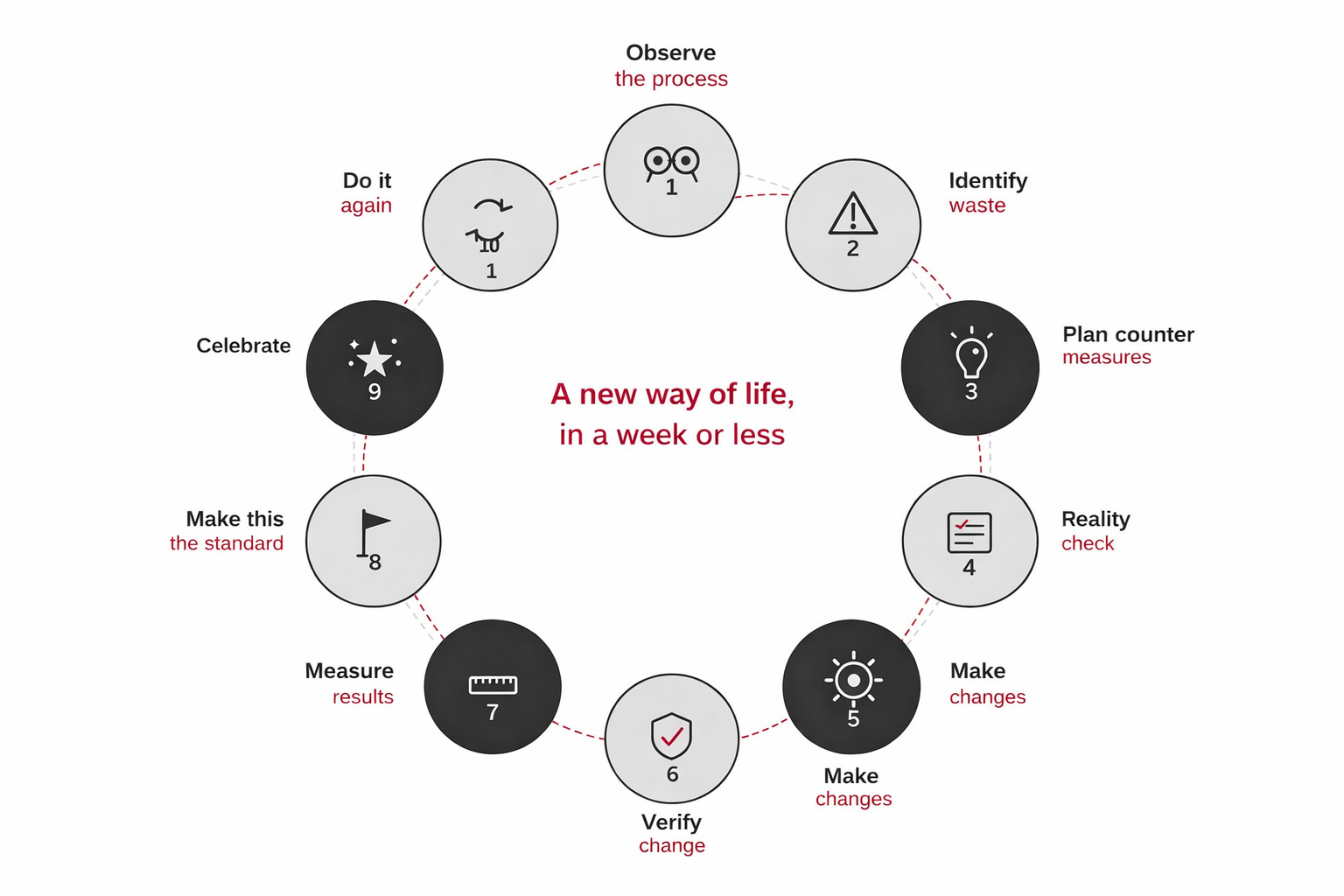
Rapid process enhancement through our Focused Improvement (FI) workshops.
Standardization
Implementation of robust practices to ensure sustainable improvements.
Sustenance
Ongoing support and frameworks to maintain and build upon achieved progress.
Key Elements
KIAP’s methodology has two core elements: Rapid Process Improvement through Workshops and Sustenance through Assessment.
Focused Improvement (FI) Workshops
Our 3 to 5 day Focused Improvement Workshops redefines processes to deliver significant, measurable gains. Cross-functional teams complete at least one significant improvement project during the session. Led by the process owner, a series of such workshops ensure improvement across the entire value stream.
Assessment-based Handholding
Post-improvement, KIAP provides assessment-based handholding to ensure sustained performance. We utilize customized checklists based on global frameworks to generate a measurable performance score. Guided by KIAP experts, cross-functional teams create a template for self-sustained, continuous improvement for further projects.
The KIAP Approach
Focused Improvement Cycles